How to ship to Alaska: an operational guide for retailers
For e-commerce small parcels, air is the only viable method to most of Alaska. Metro destinations move in 2 – 5 business days; remote communities need longer windows and contingency planning.
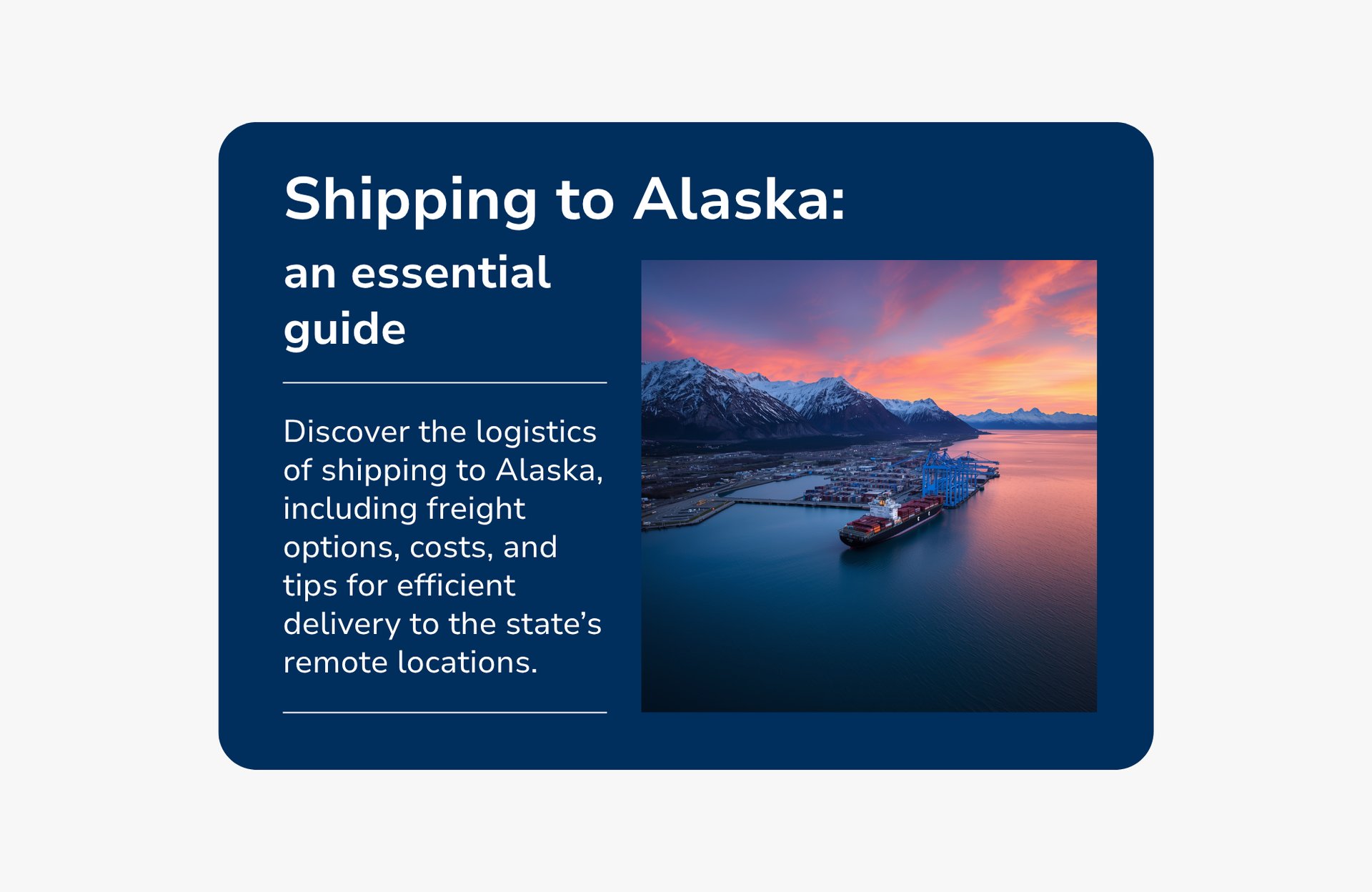
Shipping to Alaska is air-dependent across nearly all destinations. Transit times vary by destination type: most metro shipments arrive in 2-5 business days under engineered routing, and outer-region windows extend by destination, season, and access mode. Cost is driven by air capacity, distance, and how the rate card is structured for Alaska volume.
Alaska is the largest state in the country, 2.5 times the size of Texas, and the least connected to a continuous ground network. Per the Alaska Department of Transportation, roughly 35% of the state’s public roads are paved, and most communities sit beyond the road system entirely. For an e-commerce parcel that means an air leg from mainland US is structural and the transportation planning that follows from that fact looks very different from contiguous-48 shipping.
The five structural elements that determine whether a non-continental network succeeds or fails are covered in our definitive guide to shipping to Hawaii, Puerto Rico, and Alaska. This post takes those principles and works through how each one shows up in Alaska, where the geography pushes every element to its limit.
What follows is a walkthrough of how small parcel delivery in Alaska behaves: where transit windows extend and why, where cost variability comes from, and which operational details determine whether a network can hold an Alaska delivery promise across a full year.
Why shipping to Alaska requires different planning
Alaska runs three logistics profiles inside one state. Anchorage and the surrounding metro behave like a dense urban delivery market. Fairbanks and Juneau behave like mid-sized regional cities with scheduled cargo lift and predictable delivery windows. Rural interior, bush, and most Southeast Alaska towns operate on small-aircraft schedules and seasonal access, with no road link to the broader network. ASCE’s Alaska Infrastructure Report Card puts the share of communities without road access at 82%, which is the operational fact that shapes every delivery promise made into the state. Treating Alaska as one market with one transit expectation is the most common cause of Alaska delivery promise failure.
IB’s Alaska operation runs on a zone-skipping air model. Parcels consolidate at mainland US injection points, fly to Alaska on established air routes with pre-arranged cargo capacity, and process in-state through Anchorage and Juneau facilities before final delivery. That two-point in-state footprint keeps the rate card and the transit windows stable through peak periods, because the lift, the handoffs, and the volume forecasts were all built around Alaska from the start.
How delivery timeframes work when shipping to Alaska
Transit times divide along the same regional lines as the road and air networks. Metro Alaska, including Anchorage and the surrounding accessible communities, receives most shipments in 2-5 business days under engineered routing. Fairbanks and Juneau land in the same range most of the time, with seasonal capacity setting the variance. Remote interior and Southeast Alaska destinations reachable only by small aircraft or ferry move on extended windows shaped by community access pattern, weather, and aircraft availability. The reliability of any of these windows is set by network design, specifically by how parcels are inducted on the mainland, consolidated for Alaska lift, and handed off to in-state processing.
IB runs established air routes into both Anchorage and Juneau. For retailers shipping to customers in Sitka, Ketchikan, or Petersburg, that two-point in-state footprint is what makes Southeast Alaska a reliable destination on the IB network.
For addresses beyond the Anchorage and Juneau service areas, final-leg delivery depends on the destination community's access pattern. See our guide to shipping to rural Alaska for a full breakdown of bush and Southeast delivery windows.
What determines Alaska shipping cost
For a retailer shipping to Alaska, cost with an established non-continental carrier comes down to the package profile, the destination region, and the volume tier. Those variables determine the rate. The network itself is a fixed input. IB has operated Alaska lanes for over twenty years, with established air routes into Anchorage and Juneau and in-state processing built into the base rate. That architecture is built into the rate, and the rate applies consistently across clients.
Carriers without direct Alaska infrastructure do not have that pricing structure. Each additional handoff adds cost, and the residential, delivery area, extended area, demand surcharges, and net minimums that traditional carriers stack on Alaska shipments compound that variability. Businesses with consistent Alaska volume can achieve approximately 30% savings through consolidation, optimized injection, and the absence of those surcharge layers.
Box of Savings opens the same path to retailers without the volume threshold, so the network economics scale down to weekly counts that wouldn’t otherwise justify a dedicated Alaska program.
Air capacity and weather: planning for Alaska’s operational reality
Most parcels into Alaska move by air, which makes lift availability the primary variable on transit reliability. How a network secures lift, when it secures it, and what it does when capacity tightens are the questions that separate Alaska-engineered networks from carriers handling Alaska as a peripheral destination. The difference rarely surfaces on a published rate card. It surfaces under stress.
Peak retail volume tightens lift across the industry, and the squeeze hits Alaska routes harder than mainland routes because capacity into the state is naturally constrained. Networks built around Alaska secure lift ahead of those cycles, with capacity contracts written against forecasted Alaska volume. Without that planning, the slippage from a peak-season capacity tightening shows up as days added to the customer-facing window.
Weather is the second variable, and Alaska’s weather behaves differently from any other domestic shipping environment. From October through April, low-pressure systems forming over the Gulf of Alaska push heavy snow, high winds, and ceilings low enough to close approach paths into Anchorage multiple times each winter. Daylight is its own constraint. Anchorage receives about five and a half hours of daylight on the winter solstice. Fairbanks receives just under four. Most of the contiguous 48 sees nine to ten hours on the same date. Ground handling, last-mile delivery, and outdoor staging all compress into the daylight window because crew safety, road visibility, and runway lighting requirements all tighten outside it. An eight-hour mainland working day is a six-hour Alaska working day in December, shorter in the bush.
None of these conditions are considered exceptional in Alaska. They’re recurring inputs, and a network’s reliability is set by how routinely its operations have been built around them.
Visibility and technology in Alaska shipping
IB’s tracking technology was developed in-house specifically for non-continental delivery, including the Alaska lanes. Real-time visibility runs from the first induction scan on the mainland through the Anchorage or Juneau handoff to the final delivery scan. In Alaska, where weather and lift availability can shift a delivery window mid-flight, visibility lets the operations team catch a missed connection or a held flight at the scan-gap rather than at the customer-service ticket. Integrations with ProShip, ShipStation, and Shipium mean that signal flows back into the retailer’s existing workflow rather than living in a separate tool.
For retailers, the practical effect is earlier intervention when something needs handling and a single workflow for Alaska orders alongside mainland shipments.
Common mistakes when shipping to Alaska
Twenty years of Alaska lane experience surface a short list of mistakes that most retailers repeat on a first Alaska program:
Treating Alaska as a single zone with one transit promise across metro, regional, and remote
Underestimating Southeast and interior transit windows when committing to a customer-facing delivery date
Building Alaska promise dates against mainland US ground-network assumptions
Comparing Alaska carriers on the published label rate without modelling re-delivery, claims handling, and customer-service load on the back end
These mistakes share a profile. They don’t show up on a quote, they show up in the post-mortem. The label rate that won the lane gets erased once re-delivery and claims handling stack up. The customer who experienced the missed promise needs more than a refund to come back. Repairing trust on an Alaska delivery program takes longer than landing the program in the first place.
If any of those mistakes sound familiar, the answer is usually structural.
IB has operated Alaska lanes for more than 20 years. Most of the retailers we work with came to us after an Alaska promise broke at one of three places: the mainland injection, the lift into Anchorage or Juneau, or the final-leg handoff to a community without ground access. What looks like a rate problem usually turns out to be a network-design problem, and the fix tends to sit underneath the price.
What to understand about an Alaska shipping network
Five elements determine whether an Alaska network holds its delivery promise across a full year or treats Alaska as a zone exception on a mainland rate card. Reading how a candidate network handles each one is the most reliable way to evaluate whether it has been engineered for Alaska.
Owned transportation vs national carrier handoffs. Some networks book their own transportation into Alaska and control when parcels move. Others pass the parcel to a mainland consolidator, which waits for enough volume to fill its next scheduled flight before sending it. On the second path, the parcel moves at the consolidator’s pace, not the carrier’s.
The in-state model. Some networks process deliveries directly inside Alaska through more than one in-state gateway. Others route everything through a single Anchorage hub before distribution to the rest of the state. The difference shows up in Southeast and outer-region transit windows, where a single-gateway model carries the regional complexity downstream.
How transit time is defined. First physical scan to delivery is the honest measure; label creation to delivery includes time before the parcel ever moves, which obscures actual network performance.
Recovery architecture. When weather closes an approach path or peak retail compresses lift across the industry, networks operating against pre-arranged Alaska capacity restore delivery flow inside hours. Networks improvising per disruption push the cost of the disruption forward to the customer-facing window.
Rate structure. A carrier built for Alaska prices on the package profile, the destination region, and the volume tier against an established base rate. Carriers that price Alaska as a zone exception carry that variability forward to every quote and every invoice, which is why quote-to-bill accuracy is the single best diagnostic for whether the lane is being run on planned capacity.
Learn more about IB Non-Con shipping
For the architectural overview across Hawaii, Puerto Rico, and Alaska, see the definitive guide to shipping to Hawaii, Puerto Rico, and Alaska. For details on the broader non-continental network, see the IB Non-Continental shipping page.
Frequently asked questions about shipping to Alaska
How long does shipping to Alaska usually take?
With engineered routing and coordinated air lift, most shipments to Anchorage and the surrounding metro arrive within 2-5 business days under normal operating conditions. Fairbanks and Juneau land in the same range most of the time, with seasonal lift availability setting the variance. Communities reachable only by small aircraft or marine connection operate on extended windows that depend on the destination’s specific access pattern. Weather and seasonal air capacity cycles affect transit across all carriers.
Is shipping to Alaska considered international?
No. Alaska joined the Union in 1959 and ships under fully domestic protocols. There are no customs declarations, no duties, and no international forms. The transportation profile differs from contiguous-48 delivery because most of the state sits outside the ground network and depends on air or marine connections, but the regulatory and commercial framework is the same as any other US state.
What operational factors affect Alaska shipping reliability?
Reliability in Alaska shipping depends on three operational factors: air lift capacity aligned to volume, handoff discipline between mainland consolidation and in-state processing, and recovery architecture for when disruptions occur. How those three factors are wired together is what determines whether a Gulf-of-Alaska storm system, a peak-season lift squeeze, or a capacity crunch lands as a same-day operations adjustment or a multi-day customer-facing delay. For a retailer evaluating an Alaska program, those three factors carry more weight than the published rate, because they decide whether the rate stays close to the invoice across a full year of operating conditions.
Ready to ship to Alaska without the operational guesswork?
IB has operated Alaska lanes for over twenty years, with air routes into Anchorage and Juneau and in-state processing built into the base rate. Whether you're shipping consistent Alaska volume or just getting started, the network is the same.
Talk to our team about your Alaska lanes.
Not yet at volume? Box of Savings gives you the same network and processing with no minimum threshold.