Shipping to U.S. territories: an operational guide for retailers
Four U.S. territories beyond Puerto Rico – Guam, USVI, American Samoa, Northern Marianas – serve 338,000 citizens. They use domestic ZIPs and USPS final-mile, no customs. Reaching them takes a domestic-first network.
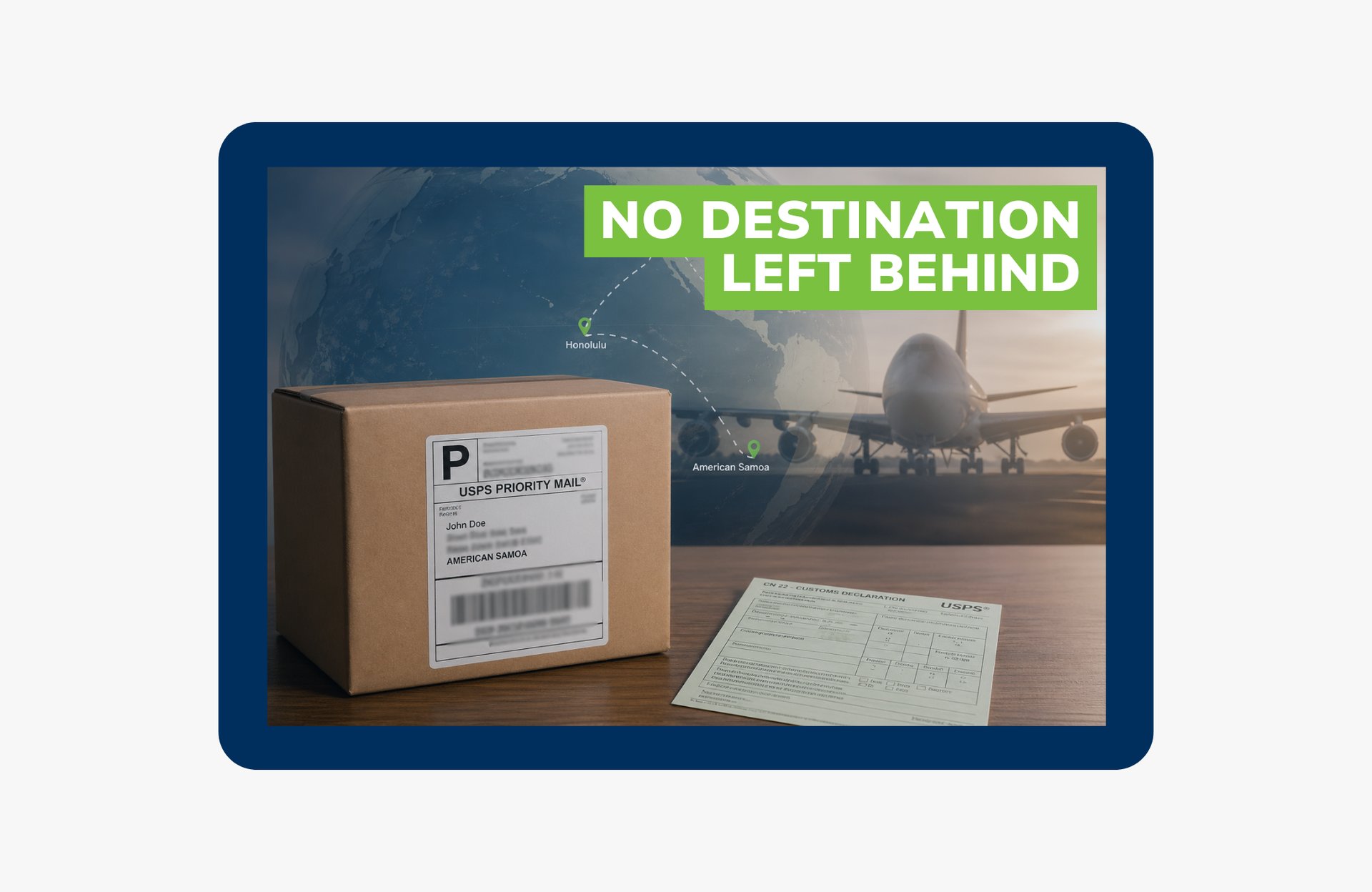
Non-continental shipping helps retailers reach U.S. territories such as Guam, USVI, American Samoa, and CNMI with the right routing and customs logic.
Four U.S. territories sit outside Puerto Rico and serve a combined population of approximately 338,000 U.S. citizens and U.S. nationals: Guam, the U.S. Virgin Islands, American Samoa, and the Commonwealth of the Northern Mariana Islands. All four use U.S. dollars, U.S. ZIP codes, and English-language commerce. All four economies are import-dependent for consumer goods, which is the structural condition that makes mainland US retail demand-relevant in the first place.
For mainland US retailers, the operational question is how to deliver to these markets reliably and at a cost-to-serve that supports inclusion in standard delivery zones. Reaching them well depends on two things: a network designed for non-continental routing (delivery to U.S. destinations outside the contiguous 48 states), and label-generation logic that applies the correct customs treatment by territory.
The four U.S. territories outside Puerto Rico
Guam. A Western Pacific island and unincorporated U.S. territory roughly 3,800 miles west of Hawaii. Population 153,836 per the 2020 U.S. Census. ZIP codes 96910 through 96932.
U.S. Virgin Islands. A Caribbean territory comprising St. Thomas, St. Croix, and St. John, east of Puerto Rico. Population 87,146 per the 2020 U.S. Census. ZIP codes 00801 through 00851.
American Samoa. A South Pacific territory of five main islands and two atolls, roughly 2,600 miles southwest of Hawaii. Population 49,710 per the 2020 U.S. Census. ZIP code 96799.
Commonwealth of the Northern Mariana Islands (CNMI). A Western Pacific commonwealth of 14 islands roughly 130 miles north of Guam, with population concentrated on Saipan, Tinian, and Rota. Population 47,329 per the 2020 U.S. Census. ZIP codes 96950 through 96952.
Mainstream carrier networks were not designed to serve these destinations efficiently, so the cost-to-serve and exception risk make exclusion the default response. A network purpose-built for non-continental delivery handles them as primary lanes rather than exceptions.
How customs requirements work by territory
All four territories sit outside the U.S. Customs Territory and have their own customs authorities. USPS treats mainland US parcels to these destinations as domestic for postage purposes, but the customs paperwork requirement at the label level differs by territory.
CN22 is the customs declaration form USPS uses in the postal stream to capture content description, value, weight, country of origin, and an HS tariff code (Harmonized System code, used to classify goods for customs). The trigger for CN22 on inbound parcels from the mainland is set in USPS Domestic Mail Manual 608.2., and the rule applies by destination and by parcel weight.
U.S. Virgin Islands
USPS handles mainland-to-USVI parcels through the postal stream as domestic mail. USVI is not on the DMM 608.2.4 list of destinations that trigger a CN22 requirement on inbound mail from the U.S. mainland, so the CN22 form is not required at the postal-stream label level for these parcels. Destination-side import duties are administered separately by the USVI Bureau of Internal Revenue, through territorial mechanisms outside the USPS customs form.
Pacific territories
Guam, American Samoa, and CNMI require a CN22 on inbound parcels weighing 16 ounces or more, per DMM 608.2.4. The rule applies regardless of declared value within that weight class. Each territory has its own customs authority: the Guam Customs and Quarantine Agency, the American Samoa Department of Treasury Customs Division, and CNMI Customs. Larger or higher-value parcels require a CN23 (PS Form 2976-A) or equivalent.
For retailers, the operational implication is that the label-generation system applies the correct logic by destination. The CN22 form generates for Guam, American Samoa, and CNMI on every qualifying parcel, and for USVI parcels through the standard domestic flow without CN22 at the postal-stream level.
Network design for non-continental delivery
The network design that makes these destinations economically viable for ecommerce treats territory routing as part of the core operating profile. Direct mainland US to Guam or mainland US to USVI air rates are expensive for a structural reason. Volume on any single mainland-to-territory lane is small. Carriers without an existing non-continental network price these lanes accordingly.
International Bridge operates a non-continental network with two decades of operating history on these lanes. That history produces the lane density required to handle territory destinations as part of standard operations, with cost-to-serve economics and transit windows direct mainland US routing through standard carrier networks cannot match.
Retailers consolidating their non-continental volume through one provider typically see better economics on the long-tail destinations than retailers running each lane through separate carriers. Reliability follows the same pattern: a network that handles these destinations as core lanes produces a more predictable transit window.
Transit windows by territory
Typical transit windows on these lanes run 3-5 business days for USVI and 6-8 business days for Guam. Standard alternatives can run materially longer or require expensive air service to deliver in a comparable window.
For lower-volume shippers, Box of Savings provides access to the same network, including territory routing, with consolidation savings of approximately 30% relative to standard carrier rates.
Integration and customs declaration generation
At meaningful order volume, customs declarations cannot be a manual back-office task. The label-generation system needs to produce a compliant CN22 or CN23 at the same point it produces the shipping label, with content data, value, weight, and HS code populated from the order record. It also needs to apply the correct logic by destination, generating the form for Pacific territory parcels at the DMM-defined weight trigger and routing USVI parcels through the standard domestic flow.
International Bridge integrates with ProShip, ShipStation, Shipium and Asendia. IB’s software, developed in-house, supports CN22 generation and customs data flow through these integrations, with destination logic that applies the correct form requirement by territory.
For retailers new to U.S. territory shipping, the customs declaration question is the part that most often stalls the build. IB’s team configures the destination logic with the retailer, walks through the form requirements territory by territory, and stays available when rules or thresholds change. The capability is built into IB Non-Con; the support around it is what makes the integration land at order volume.
A note on military addresses
APO, FPO, and DPO addresses sit alongside U.S. territories within the broader non-continental network but follow a separate operational profile, including USPS routing through the postal stream and host-nation customs treatment that varies by AE, AP, and AA region. For the operational detail on military and diplomatic address shipping, see A complete guide to APO/FPO/DPO shipping for E-Commerce businesses.
Frequently asked questions
⦿ What does shipping to U.S. territories require?
Shipping to the four U.S. territories outside Puerto Rico means delivering to U.S. citizens and U.S. nationals through a network configured for non-continental routing and territory-specific customs handling. All four territories sit outside the U.S. Customs Territory and have their own customs authorities. USPS routes mainland US parcels to these destinations as domestic mail for postage, with CN22 customs paperwork required at the label level for Guam, American Samoa, and CNMI parcels weighing 16 ounces or more under DMM 608.2.4, and not required at the postal-stream level for USVI.
⦿ What is CN22 and when is it required?
CN22 is the USPS customs declaration form used in the postal stream to capture content description, value, weight, country of origin, and an HS tariff code. The trigger is set by destination and parcel weight under DMM 608.2.4. Guam, American Samoa, and CNMI require a CN22 on inbound parcels weighing 16 ounces or more, regardless of declared value, while USVI parcels are not required to carry a CN22 at the postal-stream level.
⦿ How are USVI shipments handled differently from Guam, American Samoa, and CNMI?
USVI sits outside the U.S. Customs Territory, but USPS handles mainland-to-USVI parcels through the postal stream as domestic mail without requiring CN22 at the label level. Guam, American Samoa, and CNMI require CN22 on inbound parcels weighing 16 ounces or more per DMM 608.2.4. Routing economics differ by region, with USVI parcels following a different lane profile from the Pacific territories. The USVI Bureau of Internal Revenue may collect import duties at the destination separately, through territorial mechanisms outside USPS-level documentation.
⦿ How does IB serve the smaller U.S. territories cost-effectively?
IB serves the smaller U.S. territories through its non-continental network with two decades of operating history on these lanes. The network’s lane density supports territory destinations as standard operations, which produces measured transit windows and cost-to-serve economics that direct mainland US to territory routing through standard carrier networks cannot match.
Talk to the IB team about your U.S. territory shipping. We will review the destinations you serve, the customs logic your labels need, and how the lanes fit your current setup.
Learn more about how IB approaches non-continental shipping
For the architectural view of non-continental shipping performance across Hawaii, Puerto Rico, and Alaska, read the definitive guide to shipping to Hawaii, Puerto Rico, and Alaska.
For service details, coverage, and how IB Non-Con fits into fulfilment operations across all non-continental destinations including U.S. territories, see the IB Non-Continental shipping page.