 Skip to main content
ProShip Pinnacle 2026 was focused, well-attended, and built around a clear premise: enterprise parcel shippers are making decisions that will shape their networks for the next several years. For International Bridge, the conversations that took place confirmed something we have been observing across multiple industry events this year – shipping to Alaska, Hawaii, and Puerto Rico is no longer treated as an afterthought in multi-carrier shipping environments. It is being evaluated as a structural requirement.
As a gold sponsor and exhibiting partner at ProShip Pinnacle, IB was positioned within the expo hall alongside the technology and carrier partners that ProShip customers rely on daily.
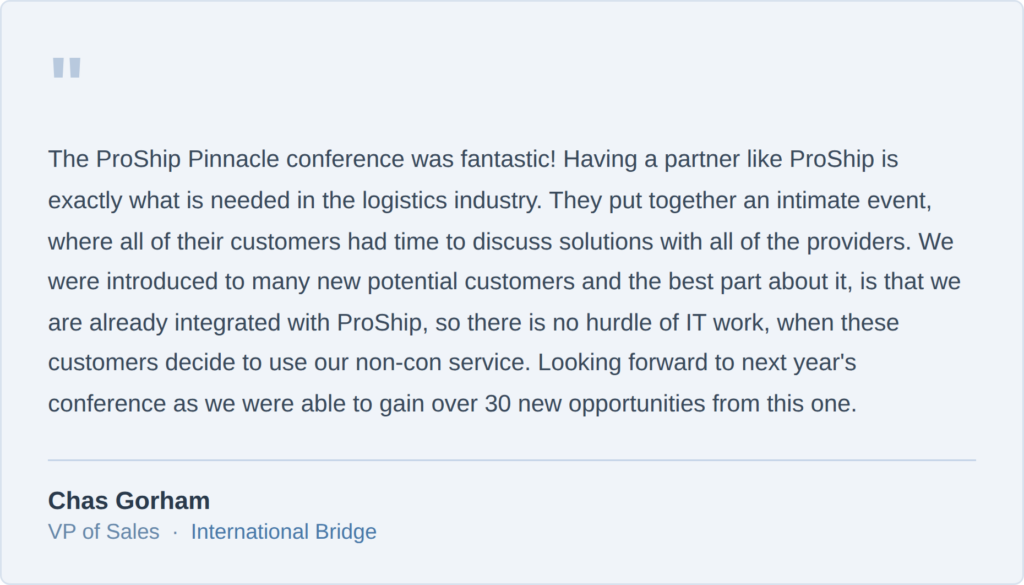
Being in that environment shaped the conversation. Attendees were not exploring whether non-continental lanes mattered. They were evaluating how to integrate them into the multi-carrier shipping strategies they are already running.
What emerged reflected the same direction we have been seeing across recent industry conversations: non-continental shipping is moving from awareness into execution planning.
Why this audience matters for non-continental shipping
ProShip’s customer base – enterprise retailers, manufacturers, and 3PLs operating multi-carrier shipping software at scale – represents exactly the profile that benefits most from a dedicated non-continental shipping partner. These are organizations that have already optimized their mainland lanes. They have rate shopping, carrier compliance, and label automation running efficiently within their existing ProShip environment.
What many have not yet solved is the final gap: reliable, cost-predictable shipping to Hawaii, shipping to Alaska, and shipping to Puerto Rico within the same multi-carrier framework that manages their mainland volume.
Across two days in Milwaukee, the recurring focus was not whether non-continental shipping mattered, but how to build it into existing networks in a way that is operationally consistent at scale.
What shifted in the conversations
At previous partner events, discussions about non-continental small parcel shipping often began with education: transit windows, air network mechanics, the operational differences between mainland ground and non-continental air. At Pinnacle, the fundamentals were largely assumed.
Attendees understood non-continental lanes require their own operating logic, with different service expectations, routing realities, and cost considerations than mainland ground shipping. At Pinnacle, the conversation moved beyond the fundamentals.
The conversations moved directly to execution. Recurring themes included onboarding timelines, how IB’s Non-Con service integrates alongside existing carriers within ProShip’s multi-carrier platform, and how teams are evaluating delivery consistency, customer promise windows, and cost predictability across non-continental lanes.
As one internal reflection from our team noted: “These were procurement-stage conversations, not discovery-stage.”
For a deeper look at the operational structure behind these lanes, see our definitive guide to shipping to Hawaii, Puerto Rico, and Alaska.
The integration advantage
One of the clearest signals at Pinnacle was how strongly non-continental shipping decisions are now influenced by a carrier’s ability to integrate into existing technology environments.
ProShip customers operate within a structured multi-carrier shipping ecosystem. Adding a new carrier in this context is not a simple rate card comparison. It involves label compliance, API connectivity, data validation, and consistent performance under automated rate shopping logic. IB’s integration within ProShip’s certified carrier library allows teams to activate non-continental lanes without interrupting their current workflows.
This level of technical readiness – being pre-integrated rather than requiring custom development – shifted the Pinnacle conversations from “can this work?” to “when do we activate?”
Reinforced direction, consistent strategy
Pinnacle, like Manifest, did not redefine IB’s approach. It confirmed the market is moving in a direction IB has supported for more than two decades.
Shipping to Alaska, Hawaii, and Puerto Rico is entering formal procurement cycles within enterprise logistics operations. The companies evaluating these lanes are not experimenting. They are building permanent network capability – and they are doing it within multi-carrier platforms where consistency, integration, and performance discipline are non-negotiable.
International Bridge exists to serve exactly this requirement. Non-continental US shipping is not an extension of our business. It is the foundation.
If your organization is evaluating how to add reliable, cost-predictable non-continental shipping to your multi-carrier strategy, learn more about our non-continental shipping solutions or contact us to start a conversation.