 Skip to main content
Air cargo is often misunderstood in non-continental lanes. When teams research how to ship to Hawaii (or compare options for shipping to Alaska, Puerto Rico, or Guam), most advice focuses narrowly on speed or the lowest label rate. But in operational reality — especially in non-continental U.S. lanes – the defining constraint isn’t fastest transit time; it’s controlling variability and exceptions that drive escalations, cost overruns, and customer dissatisfaction.
For logistics leaders prioritizing on-time delivery, stable service windows, and lower exception spend, understanding how air cargo functions as a reliability lever – not a premium speed play – is essential.
In these lanes, the real question isn’t “How fast can it move?” but “Where does variability enter the network – and how do we control it?”
That matches what we see in real shipper conversations. Leaders aren’t simply chasing “faster.” They want delivery reliability, risk containment, and cost stability – especially when customer expectations are set by marketplaces, DTC (direct-to-consumer) promises, or replenishment deadlines.
Why air cargo is often misunderstood in non-continental lanes
Non-continental delivery has built-in constraints that mainland networks can often route around:
- Fewer departure options per day (air and ocean)
- Weather and operational disruptions that create bigger downstream delays
- More handoffs between parties (each handoff increases variability)
- Capacity and pricing volatility that can change quickly
This is why air cargo to Hawaii is often less about “premium speed” and more about controlling delivery variance – especially when a missed cutoff can add multiple days, not hours.
In non-continental lanes, a single operational miss compounds faster because there are fewer recovery paths.
Unlike mainland parcel networks, there are limited same-day recovery options once a departure window is missed – which makes cutoff discipline disproportionately important.
How logistics teams actually evaluate non-continental shipping
- On-time delivery (fast and consistent)
- Stable total landed cost
- Risk reduction (claims, CX)
- Tracking visibility & communication
In non-continental shipping, cost matters — but teams are ultimately judged on on-time delivery. That means combining speed with consistency, so late outliers and recovery costs stay low.
Non-continental shipping trends that impact cost and performance
Capacity volatility
Non-continental lanes have fewer alternative departure options, so when lift shifts, performance can move fast. For a credible monthly pulse on air cargo demand, capacity, and rate dynamics, follow IATA’s Air Cargo Market Analysis.
Service level is increasingly measured as OTIF, not averages.
More shippers are aligning internal targets with what customers and retail partners measure: On-Time In-Full (OTIF) — an approach that rewards repeatable performance, not occasional “fast” deliveries mixed with costly misses.
Where air cargo improves reliability in non-continental networks
Air cargo isn’t automatically the best fit for every package. It’s most valuable when it removes the specific reasons non-continental shipments become unstable.
Protecting a customer promise
If your customer promise depends on stable delivery windows, air cargo can reduce the “miss one connection → wait days” effect that’s common on island and remote networks.
When exceptions cost more than the label
A cheaper method can become more expensive once you factor in:
- reships
- refunds/credits
- customer support time
- expedited recovery shipments
That’s why many teams shift from “lowest rate thinking” to “lowest total landed cost thinking”.
Reducing touchpoints to reduce risk
Depending on the flow, air can reduce handling and exposure to:
- damage
- loss
- delayed handoffs
- incomplete scan chains
How to ship to Hawaii: A simple decision framework (air vs ocean vs hybrid)
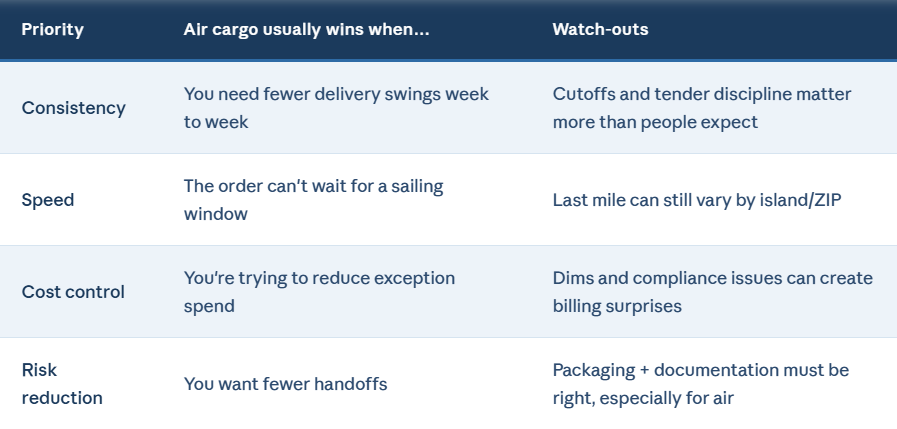
One important nuance: “Hawaii” is not one lane. Main-island vs. outer-island delivery can behave differently due to departure frequency and last-mile complexity. The same “one promise fits all ZIPs” approach that works on the mainland can backfire in Non-Con.
For example, Oahu typically offers more consistent downstream routing options than certain outer-island ZIPs, which may experience additional transfer points or reduced delivery frequency. Planning at ZIP-level granularity materially reduces escalations.
Why air freight to Hawaii fails at the last mile (compliance reality check)
Air networks are less forgiving when it comes to restricted or regulated commodities (for example, lithium batteries). If you ship products that could trigger additional requirements, build a checklist into your packing workflow.
Authoritative reference:
- TSA cargo (industry information): Cargo Programs | Transportation Security Administration
Air compliance holds can quickly eliminate any theoretical transit advantage, especially when documentation or labelling errors delay release.
How IB engineers reliability in non-continental air cargo
A common question we hear is: “How does IB actually deliver packages to non-continental areas?”
At a high level, IB’s Non-Con service is designed to make shipping to destinations like Hawaii, Alaska, Puerto Rico, Guam, and the U.S. Virgin Islands feel less like a gamble and more like an engineered network – by focusing on reducing avoidable variability and improving predictable outcomes. One practical differentiator is how IB engineers cutoffs and lift allocation by lane. Instead of relying on generic mainland tender windows, cutoffs are structured around non-continental departure frequency and downstream recovery risk – reducing the chance that one late tender cascade into multi-day delays.
Cutoff design and lift allocation are calibrated to lane-specific departure behavior – not averaged mainland assumptions – which materially lowers recovery risk in constrained markets like Hawaii.
This approach focuses on controlling where variability enters the flow, not just accelerating linehaul.
Explore more IB Non-Con education here:
https://www.myib.com/blog
Operational moves that improve air cargo outcomes in non-continental lanes
- Treat cutoffs like production deadlines (because they are).
Late tendering is one of the fastest ways to turn “air” into “not air. - Standardize packaging to control dims and reduce billing volatility.
Dims affect cost and consolidation options. - Segment orders by service need.
Not every order needs air cargo to Hawaii. Build rules by SKU, order value, customer tier, or promised delivery date. - Plan separately for outer islands / remote delivery behavior.
Blanket promises create escalations.
Avoid applying mainland SLA logic to non-continental ZIP codes without lane validation.
If you’re trying to reduce delivery variability and surprise costs in non-continental shipping – especially shipping to Hawaii and shipping to Alaska – IB’s non-continental service is built for predictable performance, not just faster linehaul.
Q&A: Air cargo + non-continental shipping
How do I ship to Hawaii reliably?
Reliability typically comes from combining:
- the right mode (air, ocean, or hybrid) for your promise window,
- disciplined tendering (meeting cutoffs), and
- a network designed to reduce avoidable handoffs.
If reliability is the goal, optimize for consistency, not the single fastest transit time.
Is air cargo to Hawaii always faster end-to-end?
Not always. Air linehaul is faster, but total delivery time can still be impacted by:
- missed cutoffs,
- capacity constraints,
- downstream delivery differences by island/ZIP,
- compliance holds (especially batteries or regulated materials).
What’s the biggest mistake companies make with air freight to Hawaii?
Treating “Hawaii” as one lane and promising one blanket transit time. Main-island vs. outer-island behavior can differ, and that variability drives escalations if it isn’t planned for.
Is the cheapest rate the best way to lower shipping cost to Puerto Rico, APO/FPO, Hawaii, or Alaska?
Often no. The lowest label cost can create higher total cost once you include:
- reships and refunds,
- customer support time,
- expedited recovery shipments,
- claims and damage.
A better target is the predictable total cost.
What items can’t go by air cargo?
It depends on the commodity, packaging, labelling, and documentation. Lithium batteries and other regulated materials can require special handling.
How can I improve tracking visibility for non-con shipments?
Focus on fundamentals:
- clean label and address data,
- correct service selection,
- consistent induction/tender scans,
- realistic customer-facing ETA language (especially for outer-island/remote ZIPs).
The Reliability Case for Air Cargo in Non-Continental Shipping
Navigating Hawaiian (and other non-continental) shipping isn’t about chasing the lowest label rate or the single fastest transit. It’s about repeatable on-time performance you can plan around.
By combining disciplined air cargo use with an engineered network and smart visibility, teams can turn these lanes into a strength – not a volatility risk.
IB’s non-continental service is built on this principle: fewer avoidable handoffs, tighter scheduling discipline, and integrated visibility – so you can confidently set realistic promises to customers, avoid last-minute recovery shipments, and focus on growth instead of firefighting.
If delivery reliability to Hawaii, Alaska, or Puerto Rico is part of your 2026 network design, explore IB’s engineered non-continental air strategy.