 Skip to main content
Speed, cost, and predictability explained
For e-commerce retailers expanding beyond the mainland United States, one question comes first:
How long will it really take to ship to Hawaii, Puerto Rico, or Alaska – and can we trust that timeline?
These destinations are domestic. But they do not behave like standard mainland ground networks.
Shipping to Hawaii, Puerto Rico, and Alaska requires specialized non-continental network design built around coordinated air transportation, local infrastructure, disciplined routing, and recovery planning. Networks not engineered specifically for these lanes often rely on indirect routing and improvised handoffs – increasing variability and cost.
Non-continental shipping is not a niche extension of domestic logistics. It is a distinct operating environment with its own performance rules.
International Bridge has specialized in small parcel and e-commerce shipping to these markets for over two decades, building infrastructure in regions many national carriers treat as secondary. This guide explains how predictable sub-five-day delivery is engineered – not advertised.
What is non-continental shipping?
Non-continental shipping refers to parcel delivery to U.S. destinations outside the contiguous 48 states, including:
⦁ Hawaii
⦁ Alaska
⦁ Puerto Rico
⦁ U.S. territories
⦁ Military APO/FPO/DPO addresses
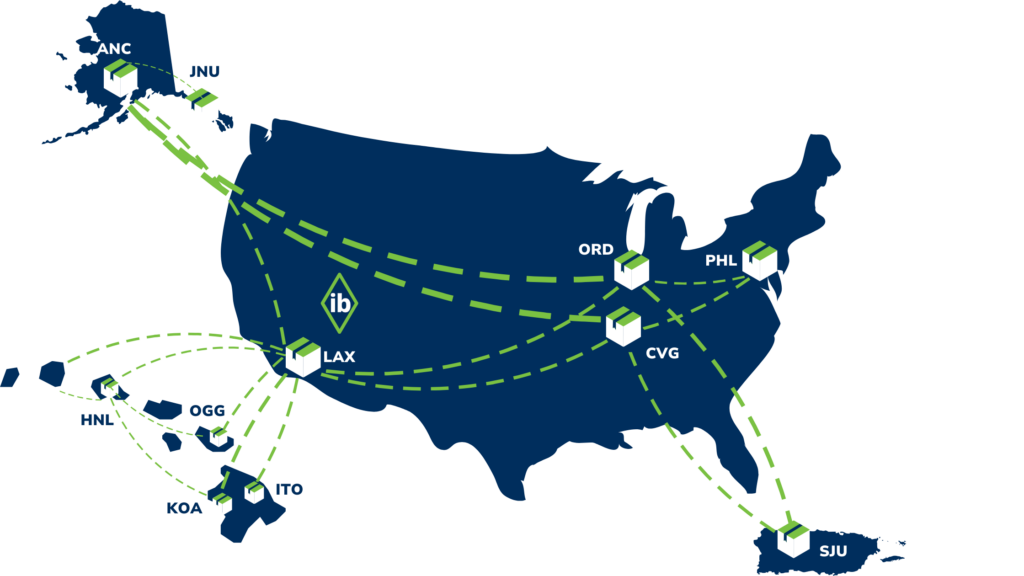
Military APO/FPO/DPO shipments operate within the U.S. postal framework but rely on specialized routing and structured handling distinct from standard mainland networks.
While these shipments are domestic from a regulatory standpoint, they depend heavily on coordinated air lift and localized infrastructure.
They are domestic – but operationally distinct.
Realistic transit expectations
Across Hawaii, Puerto Rico, and Alaska, mature non-continental networks operate within a 2–5 days performance-supported delivery window.
In our network, over 95% of metro-area parcels are delivered within four days, with a meaningful share arriving in three.
These ranges reflect sustained commercial volume – not short-term or promotional benchmarks.
Performance numbers, however, only matter if transit is defined consistently.
What transit time actually means
Transit time is not defined uniformly across carriers. It may refer to:
⦁ Label creation to delivery
⦁ Pickup to delivery
⦁ First physical scan to delivery
At International Bridge, transit is measured from first physical scan to delivery.
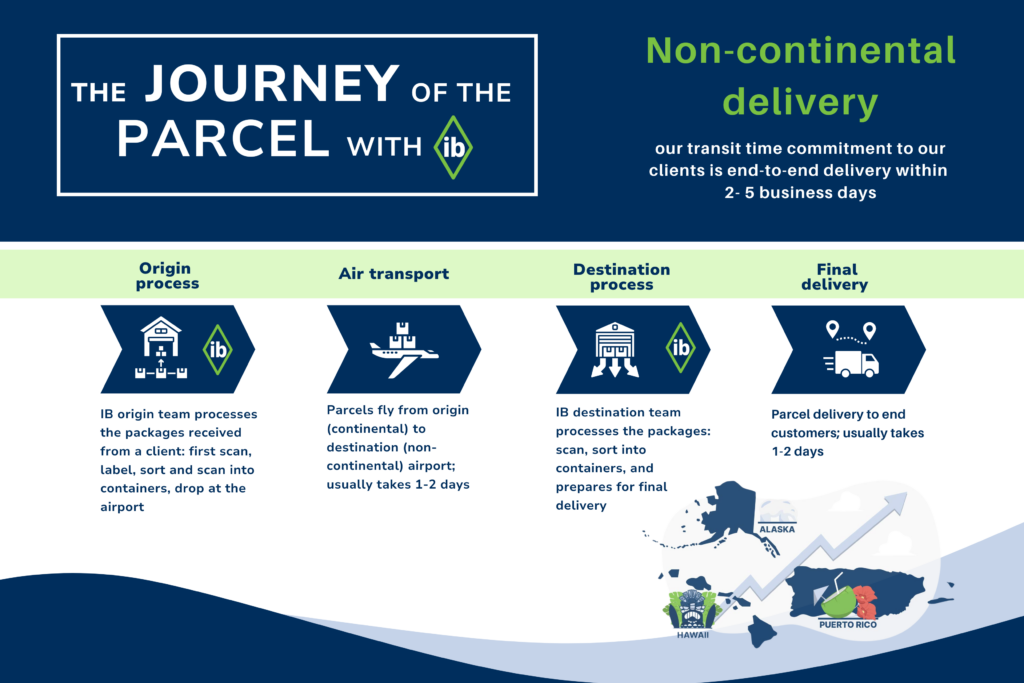
Label creation often occurs before a parcel physically enters the delivery network. Retailers may generate labels at various stages of the fulfilment process – sometimes days before handoff to a carrier. That time belongs to the broader supply chain. From a carrier performance standpoint, transit begins when the shipment receives its first physical scan inside the network. Two carriers can quote the same number while measuring entirely different windows.
Without clarity in definition, comparisons lose meaning.
Core principles of non-continental network design
Reliable shipping to Hawaii, Puerto Rico, and Alaska depends on five structural elements:
1. Coordinated air lift capacity
2. Local island or regional facilities
3. Engineered partner handoffs
4. Data integrity and verification discipline
5. Contingency and recovery planning
When one element weakens, variability increases.
When all five align, delivery within a consistent multi-day window becomes repeatable rather than theoretical.
Mature networks treat data validation as infrastructure, not as an afterthought. Reliable execution in non-continental markets depends not only on transportation capacity, but on data integrity – accurate address formatting, structured handoff information, and system-level verification that reduces avoidable disruptions.
Many networks claim speed. Fewer design for recovery when flights shift, weather disrupts schedules, or partner handoffs tighten. Stability is the differentiator.
Why non-continental strategies fail
Common structural weaknesses include:
⦁ Applying mainland ground assumptions to air-dependent markets
⦁ Indirect air routing through multiple hubs
⦁ Limited local infrastructure
⦁ Treating address validation as secondary
⦁ Designing for average days instead of recovery events
Most instability in these markets is not geographic. It is architectural.
Transit expectations by region
Shipping to Hawaii
Shipping to Hawaii from the mainland typically falls within a consistent multi-day delivery window when supported by coordinated air lift.
While ocean freight serves bulk cargo, time-sensitive parcel shipping depends entirely on air transportation. Flight schedules, capacity allocation, and routing discipline determine reliability.
Networks built around direct mainland-to-island flights reduce unnecessary handoffs and avoid over-concentration through a single distribution point. Poorly designed routing, by contrast, adds touches that delay recovery during peak periods.
When air coordination and local execution align, island delivery becomes predictable – without requiring premium pricing.
For a deeper look at infrastructure and routing considerations, see our guide to shipping to Hawaii.
Shipping to Puerto Rico
Domestic parcel shipping to Puerto Rico typically operates within a structured sub-five-day delivery range under disciplined networks, with over 95% of shipments delivered within 4 days.
Puerto Rico introduces a different complexity profile:
⦁ Over 1,000 miles from the mainland
⦁ High population density
⦁ Sensitive address formatting requirements
Address accuracy significantly influences performance. A missing urbanization line or incorrect ZIP format can quietly delay delivery. Many delays attributed to “transit issues” are actually data issues.
International Bridge has developed long-term expertise in Puerto Rico address validation and last-mile execution. Correct formatting reduces re-routes and failed delivery attempts – a detail often overlooked by mainland-focused carriers.
Learn more about structured shipping to Puerto Rico and how disciplined routing improves predictability.
Shipping to Alaska
Shipping to Alaska typically operates within the same performance range but requires additional engineering.
Alaska introduces:
⦁ Severe weather variability
⦁ Mountainous terrain
⦁ Extremely remote communities
In certain regions, final delivery may depend on bush planes or alternative transportation methods not found in standard mainland networks.
Consistency in Alaska depends less on peak speed and more on engineered routing, layered infrastructure, and structured partner coordination designed for remote-market conditions. In high-variability environments, proactive communication becomes as important as transportation capacity.
Explore how structured routing supports reliable shipping to Alaska.
APO/FPO/DPO shipping considerations
Military and diplomatic addresses (APO/FPO/DPO) operate within the U.S. postal framework but introduce additional routing and documentation considerations. While classified as domestic shipments, these lanes require operational familiarity and structured handling.
For a detailed breakdown of requirements and best practices, see our complete guide to APO/FPO/DPO shipping.
Mainland vs non-continental shipping
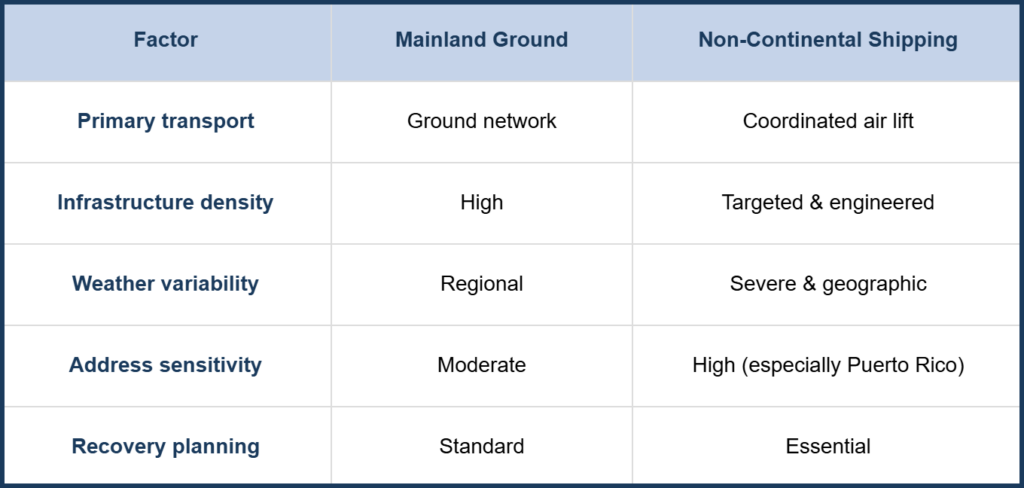
Non-continental shipping is not slower by default. It is structurally different.
Air transportation plays a significantly larger role in non-contiguous U.S. states compared to mainland ground-dense markets.
Why transit times vary
Variation in island and remote delivery markets is expected, but geography is only one variable.
Transit performance may be influenced by:
⦁ Flight schedules and air lift availability
⦁ Weather events
⦁ Carrier handoffs
⦁ Processing cutoffs
⦁ Warehouse scan timing
⦁ Peak season volume waves
⦁ Data integrity
⦁ Address validation accuracy
Variation will always exist. The determining factor is whether the network is designed to absorb it without disrupting customer expectations.
Speed versus predictability
Speed is easy to advertise.
Predictability – and margin stability – are harder to engineer.
Many retailers assume fast non-continental delivery requires premium pricing. In reality, when air lift, local facilities, and density planning are coordinated correctly, predictable sub-five-days service can reduce shipping costs by ≈ 30% compared to traditional national carrier networks.
In high-volume environments, even minor transit variability compounds into measurable margin pressure.
The difference is not speed alone – it is network architecture.
Who should approach non-continental shipping differently?
⦁ E-commerce retailers expanding nationally
⦁ Subscription-based businesses
⦁ Operations teams seeking cost stabilization
⦁ Finance teams managing margin pressure
⦁ Brands prioritizing consistent customer experience
Non-continental shipping is not simply a routing decision. It is a strategic network decision.
Designing for stability
Shipping to Hawaii, Puerto Rico, Alaska, and military APO/FPO addresses can achieve consistent 2–5 days delivery when:
⦁ Air capacity is pre-engineered
⦁ Local facilities reduce unnecessary handoffs
⦁ Data integrity prevents re-routes
⦁ Recovery planning absorbs variability
Non-continental shipping becomes predictable when designed intentionally – not improvised.
______________________________________________________
Frequently asked questions
Is shipping to Puerto Rico considered domestic?
Yes. Puerto Rico is a U.S. territory. However, reliable performance requires coordinated air lift and address validation expertise.
Is fast shipping to Hawaii only possible by air?
Yes. Time-sensitive parcel shipping relies on coordinated air transportation to achieve sub-five-day delivery.
Why can shipping to Alaska be more complex?
Severe weather, remote communities, and infrastructure constraints require engineered routing and contingency planning.
Is 2–5 days delivery realistic?
With mature air coordination, local infrastructure, and disciplined execution, 2–5 days delivery is a performance-supported range – not a promotional claim.
Does faster shipping always mean higher cost?
Not necessarily. When infrastructure, air coordination, and density planning align, predictable service can lower total shipping cost.
Designing for stability, not promises
Retailers shipping to Hawaii, Puerto Rico, Alaska, U.S. territories or military addresses benefit most from networks designed for variability – not perfection.
Predictable delivery within a structured multi-day window is the outcome of aligned infrastructure, disciplined air coordination, engineered routing, and operational maturity developed over years – not quarters.
Non-continental shipping should not require a tradeoff between speed and cost. When designed correctly, both are achievable.
The question is not whether these markets can be served predictably.
It is whether the network behind the promise was built for them.