 Skip to main content
Zone-skipping is a parcel shipping model that bypasses standard zone-by-zone rate progression by consolidating shipments at origin and injecting them downstream, closer to the destination. For e-commerce retailers shipping to addresses far from their distribution center, including any non-continental US destination, zone-skipping can collapse a high-zone parcel into something that prices and moves more like a local lane.
This post explains how the zone system works, what zone-skipping actually changes, and the conditions under which it produces meaningful cost and transit benefit. It also explains why non-continental destinations are the case where zone-skipping matters most.
What are parcel shipping zones?
Parcel shipping zones are an industry-standard rate framework used by major US parcel carriers, including USPS, UPS, and FedEx. The zone system measures distance from the parcel’s origin to its destination using ZIP code groupings. Zone 1 represents the shortest distance, typically within the same metro area or region, and zones progress upward as distance increases, ending at zone 8 for the longest domestic distances.
Carriers price parcels using a combination of weight, dimensions, and zone. Zone is the variable most directly controlled by where the parcel originates. A parcel from a Salt Lake City distribution center to Boston might price at zone 6 or 7. The same parcel from a New Jersey distribution center to Boston would price at zone 2 or 3.
For shipments to non-continental destinations, the zone structure works differently. Hawaii, Alaska, Puerto Rico, and the US territories sit at the top of the zone ladder. Depending on carrier and origin, these destinations typically fall into zones 6 through 8. There is no zone 1 or zone 2 to Hawaii from any mainland US origin, because there is no geographic origin close enough.
The full US domestic zone chart is published by USPS at postcalc.usps.com/domesticzonechart.
How zone-skipping works
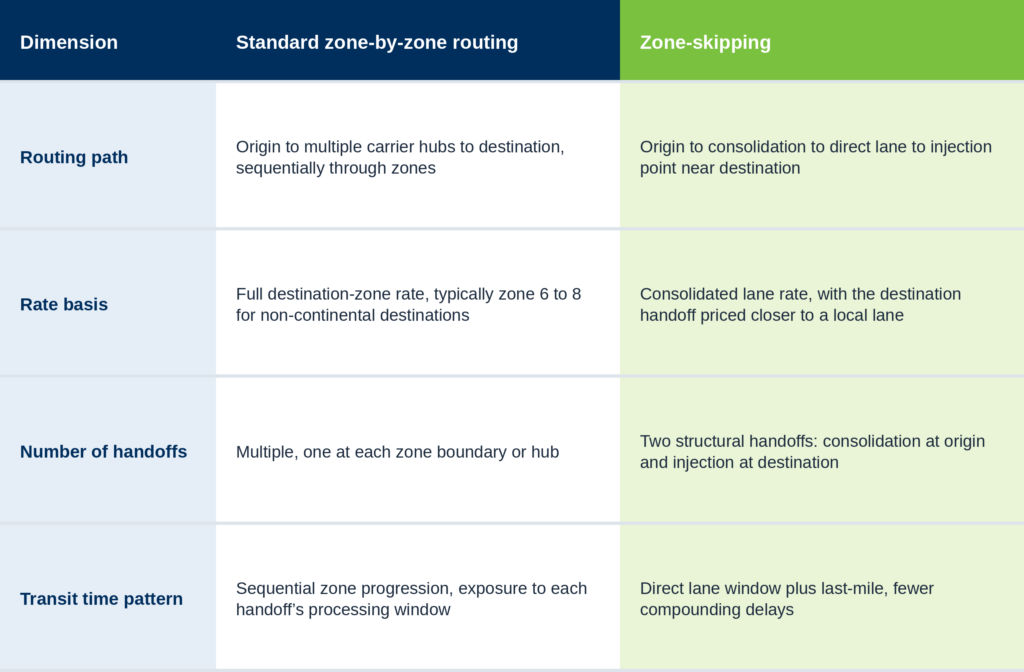
Standard parcel routing follows the zone ladder. A parcel from a single distribution center to a far destination is priced at the destination zone and moves through carrier facilities in sequence as it progresses toward the recipient. Each handoff adds cost, time, and exposure to handling errors.
Zone-skipping replaces zone-by-zone progression with two structural moves. Parcels destined for the same general region are consolidated into a single unit at origin. That consolidated unit moves on a direct lane to an injection point near the destination, bypassing the intermediate handoffs along the way. From the injection point, the parcel enters local delivery as if it originated nearby.
The effect on rate and transit is structural. A zone 8 parcel routed through zone-by-zone progression carries the cost of moving long distance through multiple carrier handoffs. The same parcel inducted at destination through a direct consolidation lane prices closer to a local delivery, because the long-distance portion happened in bulk before the parcel entered local delivery networks.
Standard routing vs. zone-skipping at a glance
When zone-skipping makes sense
Zone-skipping produces meaningful savings and transit benefit when three conditions hold together.
The origin-to-destination distance crosses multiple zones
Zone-skipping creates upside by collapsing zone progression. A shipper sending parcels short distances is already in low-zone territory and has nothing to skip.
Volume meets the consolidation threshold
Consolidation requires critical mass. A shipper sending a handful of parcels per week to a given region usually rides existing carrier networks instead.
The destination sits far from every distribution center the shipper operates
Zone-skipping is redundant if the shipper already has a DC close enough to ship from a low zone. For non-continental shipping, this condition is automatically true: no mainland distribution center is geographically near Honolulu, Anchorage, or San Juan, regardless of which coast the shipper operates from.
Why non-continental shipping is the strongest case for zone-skipping
After more than two decades operating non-continental lanes, IB sees zone-skipping as the structural answer to a structural problem: top-of-ladder zone math with no nearby origin to collapse it.
Non-continental destinations sit outside the assumptions standard parcel networks were built around. Bulk cargo can move to these markets by ocean freight, but for e-commerce parcel volumes, every shipment to Hawaii, Alaska, Puerto Rico, the territories, or APO/FPO addresses moves by air at some point in its journey. Every parcel is also priced at the high end of the zone ladder, because no mainland origin is geographically close enough to price it lower.
The combination of mandatory air, top-of-ladder zones, and limited infrastructure at destination is what makes non-continental shipping the structural case for zone-skipping. A single distribution center in the mainland US, regardless of which coast it sits on, is operationally equivalent in zone math when shipping to Honolulu. Consolidation and direct lanes are how those routes price and perform predictably.
For IB Non-Con customers, zone-skipping into non-continental destinations produces approximately 30% cost reduction compared to standard zone-based parcel pricing, with metro transit times of 2 to 5 business days into Hawaii, Alaska, and Puerto Rico. These outcomes are direct consequences of the zone-skipping architecture: high-zone progression collapsed at origin, lift cycles pre-arranged, injection at destination.
For shippers below the volume threshold to consolidate independently, IB’s Box of Savings is the route into zone-skipping economics. It aggregates small-volume parcel flows into the same consolidation lanes that larger shippers use directly, opening the same structural cost reduction to e-commerce sellers without the volume baseline.
Frequently asked questions
Is zone-skipping the same as regional consolidation?
Zone-skipping is one form of regional consolidation, specifically the form that bypasses standard carrier zone progression by injecting parcels into local delivery near the destination. Other forms of regional consolidation move parcels into regional sortation facilities for further carrier handling. The defining feature of zone-skipping is the direct injection step that collapses the zone math.
How much can zone-skipping reduce shipping costs?
For IB Non-Con customers, zone-skipping into non-continental destinations produces approximately 30% cost reduction compared to standard zone-based parcel pricing. The reduction is structural, generated by consolidating parcels at origin and pricing the destination handoff at a local lane rate rather than a full zone 8 rate. Actual savings vary with volume, lane mix, and current routing baseline; IB can run zone math on a sample of Package Level Detail to model the specific reduction.
How long does zone-skipping take for non-continental shipments?
IB Non-Con delivers metro transit times of 2 to 5 business days into Hawaii, Alaska, and Puerto Rico using zone-skipping. The window is shorter than standard zone-by-zone routing because the long-distance portion of the journey happens in bulk on a direct lane rather than progressing through carrier handoffs. Rural and remote destinations within non-continental markets have wider windows, set by air capacity and last-mile infrastructure at the destination.
Does zone-skipping work for international shipments?
No, zone-skipping in this form is a domestic parcel shipping model. International shipments use different rate structures, customs requirements, and routing logic. The zone framework discussed in this post applies to US domestic and non-continental US parcel shipping.
How does zone-skipping affect tracking and delivery transparency?
Tracking visibility depends on how the consolidator integrates with the carrier handling final delivery. Quality zone-skipping operations provide end-to-end tracking with scan events at consolidation, transit, injection, and last-mile delivery. Shippers should confirm tracking integrates with their order management system before committing to a zone-skipping lane.
Get IB’s read on the zone math for your lanes
For non-continental shippers, the zone math conversation is worth having. If you ship to Hawaii, Alaska, Puerto Rico, the territories, or APO/FPO addresses, IB’s team will run the numbers against your current routing and show you the cost-line and transit-window impact of zone-skipping on a sample of your lanes.
Ask IB to run zone analysis on your non-continental lanes
Further reading: